
Turning interruptions into a secret spy game

Have you ever been on the phone or in the middle of a conversation when you hear that familiar, disgruntled voice calling, “Mum!” You know the one. The voice that tells you your child needs something and they need it right now! Whatever it is, it feels like the end of the world to them, and they aren’t going to stop until you put everything aside and deal with it.
When I was a young mum, I didn’t always have the best answers, my usual response was to put my arm around my child and ask them to wait a moment. Sometimes it worked, usually it didn’t, and the interruption went on until I addressed it.
But when I found myself in charge of 15 to 20 children, all needing my attention at once, I realised I needed a better solution. I wanted the children to feel comfortable coming to me when they needed my help. At the same time, they needed to learn that not everything required my immediate attention.
After giving it some thought, I came up with an idea that most of the children not only accepted but actually enjoyed.
We became spies!
We created our own secret codes, complete with special hand signals, to help us communicate without having to interrupt. And the best part? We turned learning when to wait and when to speak up into a game.
Becoming Secret Spies
Before we could become successful spies, we had to learn how to recognise the different situations we might find ourselves in.
We started by talking about three categories:
- Emergency: Something that needs my attention immediately.
- Important: Something that needs my attention soon, but can wait a little while.
- Not urgent: Something that can wait until I have finished what I’m doing.
This sounds simple enough, but it took a little practice. Children can sometimes feel that whatever is happening to then at that moment is the most important thing in the world. And, from their perspective, it often is!
Our first job was to work out what really counted as an emergency. I asked the children to come up with examples, and we talked about whether each situation genuinely needed immediate attention.
We discussed things like someone bleeding heavily, someone who had fallen and couldn’t get up, someone who wasn’t responding after hitting their head, or someone doing something dangerous. We talked about strangers and that I needed to know if someone unknown was around near the children. If a child suggested something that wasn’t actually an emergency, we’d talk about why it belonged in one of the other categories instead.
It took a while for everyone to get the hang of it, but because we were playing a game, the children were happy to keep practicing.
Our Secret Spy Codes
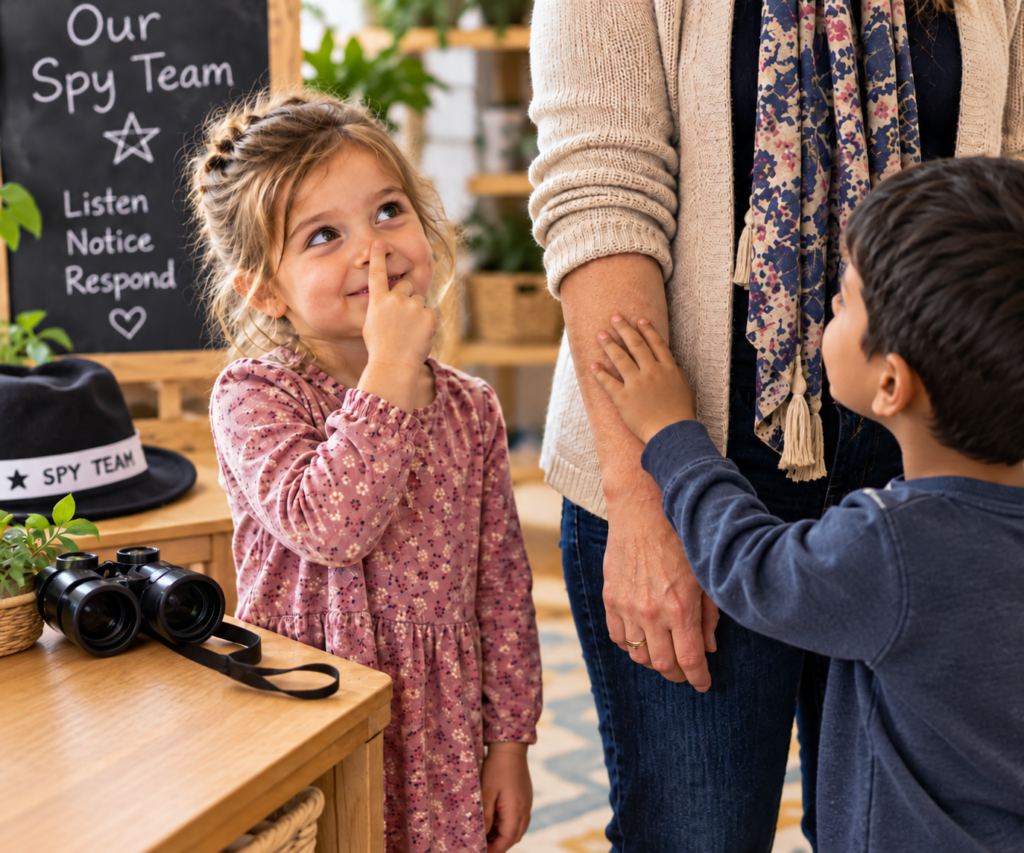
Once we understood the different categories, it was time to create our secret spy signals.
Emergency: I Need You Now!
For an emergency, we decided that the children would simply yell, “Emergency!” If something was very wrong, it wasn’t a game, and there should be no chance of a delay because someone couldn’t remember the code.
An emergency was the one call sign that could interrupt anything. If someone was seriously hurt or in immediate danger, I needed to know straight away.
We play-acted different scenarios so the children could become more confident recognising when something was an emergency and knowing what to do.
Important: I Need You Soon
Sometimes a child needed my help with something important, but it wasn’t an emergency. For these situations, the child would come over and gently touch my hand or forearm while I was talking to someone else.
I would then tap their hand to let then know I had noticed them. That was their reassurance that I knew they needed me. They could stay nearby until I had finished my conversation and was able to give them my attention.
Not Urgent: I can wait
For things that weren’t urgent, the children would stand somewhere I could see them and tap the side of their nose. I would respond by tapping my own nose and giving them a little nod.
That was their signal that I had seen them and would come and speak to them when I had finished what I was doing.
Once they received my signal, they could go back to playing or carrying on with their activity until I called them over,
It was a simple system, but it gave the children a way to let me know what they needed without having to interrupt every conversation.
The Importance of Trust
There was one very important part of our spy system that I soon realised couldn’t be overlooked: I had to prove to the children that their signals worked. It wasn’t enough to simply acknowledge them and then carry on with what I was doing. If I told a child I would come back to them, I had to make sure I did.
In the beginning, I made a conscious effort to finish my conversation or activity quickly and then go back to the child who had given the signal in good time. Patience takes time for a child to learn, and I didn’t want to test the limits of the kids too soon.
Once the children realised that I meant what I said, they became much more willing to wait. They knew that a tap on the hand or a nod, wasn’t simply a way of putting them off. It meant that I had heard them and would get back to them.
Of course, there were times when things took longer than expected, and I had to ask them to wait a little longer. But when children trust that you will follow through, they are generally much more comfortable doing so.
Without that trust, the whole system would have fallen apart.
Spy Training: Practice Makes Perfect
Of course, we couldn’t expect the children to become expert spies without a little training! We made practising our signals into a game. I would act out different situations, and the children had to decide which signal they should use.
Sometimes I would pretend that someone had fallen over and needed help. Other times, I’d act out a situation where someone needed assistance with something that could wait, or simply wanted to tell me something.
But our spy training wasn’t just about practising signals. It soon became a little like drama class, too! I would divide the children into small groups and give each group a scenario to act out. They would go off together, decide how they wanted to present it, and practise before returning to perform it in front of the rest of the class. The other children then had to decide which category the scenario belonged to an emergency, something important, or something that wasn’t urgent.
It was a wonderful way to reinforce what we had been learning, while also helping the children build confidence in acting in front of a group. There was plenty of laughter, some very enthusiastic performances, and a lot of fun along the way!
Sometimes we got things wrong, but that was all part of the fun. The more we practised, the more confident the children became at deciding when they needed my attention and when they could wait.
Being part of our secret spy team made learning these skills feel like an adventure rather than a set of rules.
When the Spies Impressed a Parent

After all our practising, the children became quite good at using their secret signals. But every now and then, one of those little moments would remind me just how useful our system had become.
I remember one particular afternoon when our secret spy system really impressed me.
I was speaking to one of the fathers when his daughter, who was well known for interrupting conversations, came over and gently touched my arm.Without breaking my conversation, I reached down and tapped her hand. She knew that meant I’d seen her and would get back to her shortly.
And then she waited.
She didn’t interrupt. She didn’t keep calling my name. She simply stood nearby until I finished what I was saying.When I turned to her, I said, “You wanted to tell me something?”
She nodded and began telling me about an activity we’d been doing that she had really enjoyed. Her father looked rather surprised. He couldn’t believe that his daughter, who apparently had a habit of interrupting conversations at home, had waited so patiently for me to finish.
He asked about the little exchange between us, so I explained our secret spy system and how the hand signals worked. He was so impressed that he asked his daughter to teach him how to use the signals at home!
I thought that was rather wonderful. We’d started our little spy game to help a group of children learn how to communicate without interrupting, and here was a parent wanting to take the idea home.
It just goes to show that sometimes, when you turn a lesson into a game, children are more than happy to join in.
What Can We Learn from Our Little Spies?
Looking back, I think the success of our little spy system came down to a few simple things.
The children were involved in creating it, so it felt like something that belonged to them. They weren’t simply being told, “Stop interrupting.” They were being given a fun and practical way to communicate. They also had a clear understanding of what was expected of them. The hand signals gave them a way to express their needs, even when I was busy.
It’s worth remembering that children don’t always interrupt because they’re being rude or deliberately difficult. Sometimes they’re excited, worried they’ll forget what they want to say, or simply haven’t yet developed the ability to wait patiently.
Learning to recognise what is urgent and what can wait is a skill that develops over time. It takes practice, guidance, and a fair bit of patience from the adults around them. The aim was never to stop the children from speaking up. It was to help them understand that there are different ways to communicate, depending on the situation.
If you have a child who frequently interrupts, perhaps you could create your own little spy system at home.
Let them help choose the signals. Practise different scenarios together. Make it something fun that belongs to your family. You might be surprised at how quickly a simple game can turn into a useful everyday skill.
A Little Patience Goes a Long Way
Teaching children to wait their turn isn’t about expecting them to sit quietly for hours or keeping their thoughts to themselves. It’s about helping them understand that their needs matter, while also learning to respect the needs of others.
For me, turning interruptions into a spy game was a simple way to teach those skills while making the children feel included and valued.
And perhaps that’s the secret to parenting. Sometimes the best solutions aren’t complicated. Sometimes, all it takes is a little imagination, a willingness to try something new, and a bit of fun.
So, the next time you hear that familiar, “Mum!” while you’re in the middle of something, perhaps you could introduce your own secret spy code.
After all, who says learning to wait can’t be a little bit of an adventure?
with love
Nana Tam
Stay Connected With Nana Tam
If you’ve enjoyed this article, why not join our growing community? Be the first to hear about new books, activities, resources and ideas from Nana Tam
Come and be part of the Nana Tam Family
Join us and be the first to hear about new books, resources, activities and little adventures as they arrive.
Welcome to the Nana Tam Family
Thank you for Joining us! We're so happy to have you along for the journey. Keep an eye out for new books, activities, resources and little adventures as they unfold.